

PMI'S PROPRIETARY FRAMEWORK
PMI's Hierarchy of Web Design Effectiveness™ — The 8-Step Framework Behind Every Website We Build
PMI's Hierarchy of Web Design Effectiveness™ is loosely based on psychologist Abraham Maslow's famous Hierarchy of Needs, which states that we must satisfy our basic survival and safety needs before we can devote ourselves to higher-level needs like achievement, respect, and creativity.
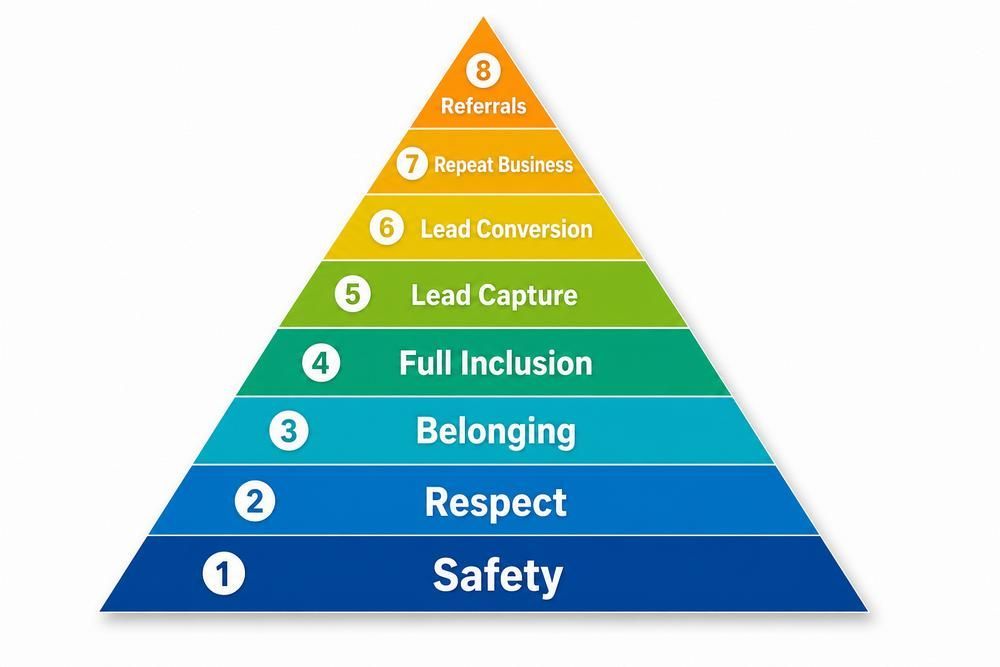
In a similar way, our framework identifies the basic web design requirements that must be satisfied before high-level goals — automated lead capture, conversion, repeat business, and referrals — can be achieved. Borrowing from Maslow's terminology, the Hierarchy of Web Design Effectiveness™ details the website development stages toward achieving increased online marketing success.
The framework is structured as an 8-step pyramid. Step #1 (Safety) appears at the base. Each successive step works its way to the top, where the website is helping you generate repeat business and referrals.
WHY THE FRAMEWORK MATTERS
Why a Hierarchy — and Not a Checklist?
Most web design firms work from feature checklists: responsive design, fast load times, contact forms, calls to action. These features are necessary, but they are not sufficient. A website that has every feature on a checklist can still fail to produce business results — because the features only matter when they are stacked in the right order, on top of the right foundation, and pointed at the right outcome.
PMI's framework treats web design as a hierarchy of dependencies. You can't earn a referral from a visitor who never converted. You can't convert a visitor who never trusted you. You can't trust a website that doesn't load, doesn't load quickly, or appears unprofessional. Each step in the hierarchy is a prerequisite for the steps above it — and the highest-impact business results live at the top.
This is why PMI begins every web design engagement by auditing where a client currently sits on the hierarchy. A small business with a beautiful brand-new website that ranks well but never produces inbound leads is stuck somewhere between Step 4 and Step 5 — they have Full Inclusion but not Lead Capture. The fix is targeted to that specific gap, not a from-scratch rebuild.
FOUNDATION TIERS — STEPS 1–4
The Foundation Tiers — What Every Website Must Earn First

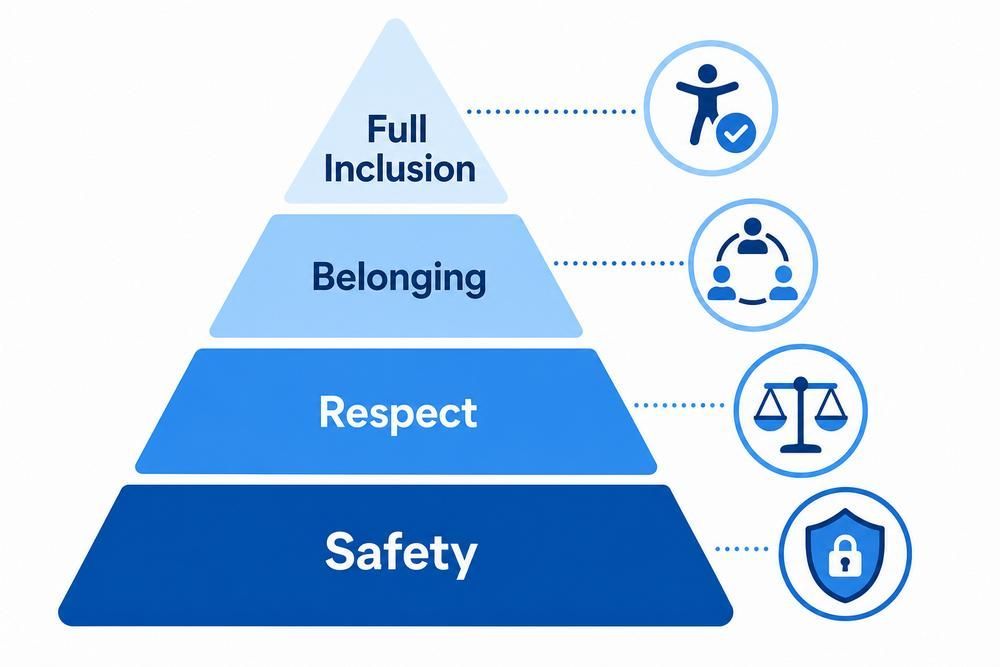
Safety
A website that fails the Safety test cannot reach a single visitor. Safety means HTTPS encryption, modern security certificates, clean malware-free code, and a hosting environment that does not get blacklisted by browsers or search engines. Visitors should never see a "this site is not secure" warning. Search engines should never flag the site for security issues. This is the floor.

Respect
Once a visitor reaches the site safely, the visual and structural quality of the site has roughly two seconds to earn respect. Respect comes from professional design, intentional typography, strong photography, mobile responsiveness, and load speeds under three seconds. A site that fails the Respect test loses the visitor immediately — bounce rates spike, time-on-site collapses, and no other tier of the hierarchy gets a chance to operate.

Belonging
A visitor who respects the site needs to recognize it as relevant to their need. Belonging means the homepage messaging immediately answers the question "is this for me?" with specifics: industry, geography, business size, problem type. A generic-everything-for-everyone homepage fails the Belonging test even when it ranks well in search.

Full Inclusion
Full Inclusion means the site is accessible to every visitor who would benefit from it. WCAG accessibility compliance. Mobile-first responsive design that works on small phones in bright sunlight. Multilingual support where the audience demands it. Properly structured headings, alt text, and form labels. Full Inclusion is also where on-page SEO discipline begins — because Google's crawlers are visitors, too, and the structures that make a site accessible to humans also make it readable to search engines.
GROWTH TIERS — STEPS 5–8
The Growth Tiers — Where Websites Become Business Engines

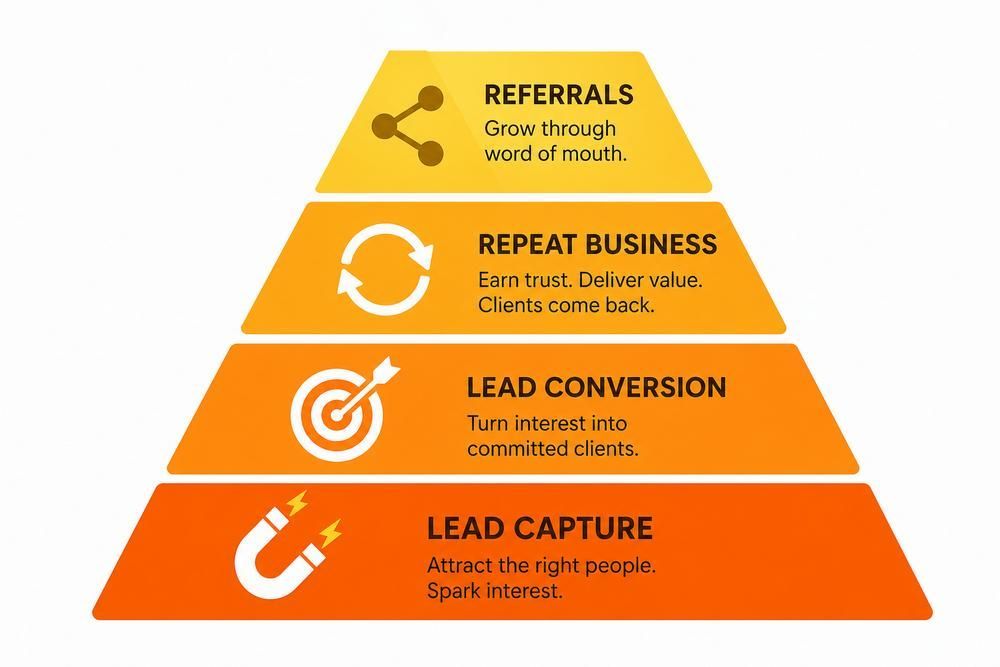
Lead Capture
A site that has earned the foundation tiers is now ready to capture leads. Lead Capture means strategic CTAs in the right places, friction-minimized contact forms, lead magnets that match real visitor questions, and clear next-step pathways for visitors at different stages of the buying journey. PMI's discipline is that every page has a primary CTA — and the visitor should never have to scroll to find it.

Lead Conversion
Captured leads do not automatically become customers. Conversion means the messaging, the proof points, the social proof, and the follow-up choreography are aligned to move a captured lead through to a closed engagement. This is where website copy stops being an exercise in describing services and becomes an exercise in answering objections, building confidence, and giving a prospect the language to internally champion the engagement.

Repeat Business
A site that converts a customer once should be designed to convert that customer again. Repeat Business comes from clear product/service expansion pathways, post-purchase content that keeps the relationship warm, account areas that make ongoing engagement easy, and email integration that maintains the connection between purchases. The compounding economics of repeat business are why a site optimized for conversion alone is leaving money on the table.

Referrals
At the top of the hierarchy is the website that produces referrals — visitors who tell others about it, customers who recommend it, and content that gets shared organically. Referrals are the highest-leverage, lowest-cost source of new business in any service economy. They emerge from a website that has earned every tier beneath them and one that makes sharing effortless: shareable case studies, quotable content, testimonial cards designed to be screenshotted, and simple, sincere referral mechanics.
HOW PMI USES THE FRAMEWORK
How PMI Uses the Hierarchy in Real Engagements
Every PMI web design engagement begins with a hierarchy audit. We rank the current site's performance at each tier — sometimes through analytics review, sometimes through guided observation of a real prospect using the site, sometimes through structured competitor analysis to see how the site stacks up against the websites the client is actually losing prospects to.
The audit produces a tier-by-tier scorecard and a prioritized action plan. A site that scores 8/10 on Safety through Belonging but 3/10 on Lead Capture doesn't need a redesign — it needs a CTA strategy, a lead magnet, and a contact form rebuild. A site that scores well on Lead Capture but poorly on Lead Conversion needs better proof points and follow-up choreography, not more visitors.
This diagnostic discipline is why PMI builds websites that produce measurable business outcomes for our clients — not just websites that look good. The framework keeps the engagement honest about what is actually broken and what is actually working.
Where Does Your Website Sit on the Hierarchy?
A free PMI consultation includes a hierarchy audit of your current website — tier by tier, with concrete observations and prioritized recommendations. You walk away with a real, actionable read on where your site is producing results, where it's leaking, and what specific changes would unlock the next tier of effectiveness.