

OUR APPROACH — THE PMI METHODOLOGY
Why the Integrated Approach Is the Only Approach That Works
If you've ever felt like your digital marketing isn't adding up — that you're spending money on a website, some SEO, and maybe some ads, but the results don't match the investment — there's a very specific reason for that.
Most businesses buy digital marketing in pieces. A web designer here. An SEO company there. Someone to run the ads somewhere else. Each vendor works in isolation, optimizing their own slice without any awareness of how the other pieces interact. The website isn't built for the SEO. The SEO doesn't align with the ads. The ads send traffic to pages that weren't designed to convert.
PMI's integrated approach isn't a recent agency-marketing trend we adopted. It's a 30-year practice in systems thinking that PMI's founder, Alan Robezzoli, has carried across three industries. It started with custom inventory and production-planning software for one of Pennsylvania's most disciplined manufacturers, JLG Industries — a Class A certified facility where every part of the system had to integrate with every other part or the whole thing failed. It deepened across an 18-month custom ERP build for Perform Group, the parent of Curtain Call Costumes — a system whose integrated forecasting, scheduling, and order-configurator pipeline produced a 10% sales lift in its first year and ran for 20 years. It came of age at Elite Sportswear, where the same integration discipline produced the gymnastics industry's first online custom garment configurator, its first international multi-currency multilingual B2B/B2C site, and an international expansion that grew the distributor network from one to thirty in three years and pushed international sales to 10% of total revenue within four years — culminating in an exclusive worldwide Adidas licensing agreement. And in 2011 it became PMI — the same discipline, applied now to the websites, SEO programs, and Google Ads campaigns that grow Berks County and Lehigh Valley small businesses.
The fragmented approach does not just produce coordination problems — it produces incentive problems. Your web designer is incentivized to build something impressive. Your SEO vendor is incentivized to show ranking movement. Your ads manager is incentivized to maximize click volume. None of them are automatically incentivized to optimize for the thing that matters: qualified leads that become paying customers.
PMI's integrated model creates a different incentive structure. When the same team manages your website, your SEO, and your ads, our success is measured by your business results — not by individual-channel metrics. If your website converts well but your SEO is not driving the right traffic, that is a problem we own entirely. There is nowhere to hide and nobody else to blame. That accountability is what drives results.

THE METHODOLOGY
Our Four-Step Strategic Process
Before any work begins — before design, before content, before a single ad runs — PMI completes four strategic steps that most agencies skip entirely. These steps are the reason our clients see results when previous agencies left them frustrated.

Competitor & Industry Analysis
We start by studying your competitive landscape in depth. Which competitors are ranking on page one, and why? What are they saying to your prospects? Where are the gaps — the positioning opportunities your competitors have left open? This analysis isn't a checkbox. It's a genuine intelligence exercise that informs everything we build for you.
The goal is to enter your market with clear eyes — understanding exactly what you're up against and what it will take to stand out in search results and in the minds of your potential customers.

Keyword Research
Keywords are the foundation of all digital marketing. We identify the specific phrases your ideal customers use when they're searching for what you offer — not just the obvious broad terms, but the long-tail, high-intent phrases that indicate a prospect who is close to making a decision.
These keywords shape your website architecture, your content strategy, your SEO campaign, and your Google Ads targeting. When all three services are built around the same keyword intelligence, everything reinforces everything else.

Messaging & Branding
What makes your business the right choice for a prospect in Reading or Bethlehem? What do your customers worry about before they buy? What do your best customers say about why they chose you? We dig into these questions to develop messaging that resonates — clear, honest value propositions that speak directly to your target customer's concerns and aspirations.
This messaging runs through every page of your website, every ad we write, and every piece of content we create. Consistency of message is one of the most underrated factors in marketing effectiveness.

Strategy & Execution Plan
With the competitive intelligence, keyword map, and messaging framework in place, we build your execution plan. Which services make the most sense given your goals and budget? What should be built first? Where is the fastest path to measurable results? What does the 12-month growth trajectory look like?
This plan becomes the roadmap for every decision we make on your behalf — and we revisit it regularly to ensure the strategy is adapting as your market evolves.
How Long Does the Strategic Process Take?
The four-step process typically takes one to two weeks before execution begins. For a business with a clear niche and manageable local competition, we can complete the analysis and present the strategy within a week. For businesses in more complex markets with multiple service lines and broader geographic targets, the process takes longer — and the additional time is worth it.
Rushing the strategy phase is the most common mistake in digital marketing engagements. An agency that presents a proposal before conducting competitive research is guessing. At PMI, you receive a proposal only after we have done the work to understand your market. That is why our proposals are specific rather than generic — they reflect actual research, not a template.
THE INTEGRATION ADVANTAGE
Why Integration Matters
Here's a specific example of what integration produces that siloed vendors cannot. When PMI runs Google Ads alongside your SEO, the data from your ad campaigns tells us which keywords are actually converting — not just generating traffic, but producing real leads. Those high-converting keywords become the priority targets for your organic optimization. Your SEO efforts accelerate because they're informed by real buyer behavior, not assumptions.
Similarly, the landing pages we build for your Google Ads campaigns are designed with the same conversion principles as your main website. There's no jarring disconnect between your ad and the page a prospect lands on. Messaging is consistent. The call to action is clear. Conversion rates go up.
This kind of cross-service intelligence only happens when one team manages everything. That's the PMI advantage.
It's also a discipline PMI's founder has applied at far larger scale. At Elite Sportswear, the gymnastics industry's first online custom garment configurator, its first multi-currency multilingual B2B/B2C site, and the international sales infrastructure that built the largest international sales force in the gymnastics industry weren't built as separate projects by separate teams. They were one integrated system designed and operated under one strategy. The result was a top 2% national ranking in website marketing effectiveness — a measurable outcome that depended on every layer reinforcing every other layer. Frank Maier, then Director of Olympic & Regional Sports, Licensing & Distribution at Adidas, attributed the success to the precise blend PMI now brings to its small-business clients: "combining Internet technology with real sales/marketing, IT, and operational know-how." Integration is not a slogan at PMI. It's how this practitioner has worked for three decades, across three industries.
How Long Does the Strategic Process Take?
The four-step process typically takes one to two weeks before execution begins. For a business with a clear niche and manageable local competition, we can complete the analysis and present the strategy within a week. For businesses in more complex markets with multiple service lines and broader geographic targets, the process takes longer — and the additional time is worth it.
Rushing the strategy phase is the most common mistake in digital marketing engagements. An agency that presents a proposal before conducting competitive research is guessing. At PMI, you receive a proposal only after we have done the work to understand your market. That is why our proposals are specific rather than generic — they reflect actual research, not a template.
The Compounding Effect of Integration Over Time
The integration advantage compounds over time. As your SEO builds organic authority, your Google Ads Quality Scores improve because users already recognize your brand from organic search — which lowers your cost per click. As your website content improves through ongoing SEO work, your ad landing pages improve simultaneously. As Google Ads data accumulates, it informs content strategy and SEO targeting with real buyer behavior data that research alone cannot provide.
Over 12 to 24 months, a properly integrated PMI strategy produces a marketing ecosystem that is fundamentally more efficient than the sum of its parts. The same budget that produced a certain number of leads in month three produces significantly more in month eighteen — because every service feeds intelligence and authority to every other service. This is why PMI clients who maintain the program long-term consistently see their cost per lead decline even as market competitiveness increases. You are building a durable asset, not renting impressions.
American Insuring Group is the clearest current illustration. PMI has architected and maintained the agency's website SEO-first since the relationship began, paired with a metronome-cadence content program that has been running consistently for over a decade. The 20-year-established Pennsylvania insurance agency now generates almost all of its new business from organic search — including some of the largest trucking-insurance leads in their market — with no cold-calling effort and no recurring ad spend. President David Ross summarizes the outcome with the candor only a long-term result allows: "Your content marketing strategy keeps proving itself year after year. Instead of cold calling, our efforts are now focused on following up on the multiple high-quality website leads we receive weekly. The return on investment has been outstanding." That is what integration plus consistency produces over a decade. It is the strongest proof point we can offer for the model PMI was built around.

Is the Integrated Approach Right for Every Business?
The honest answer is: the full integrated model — analytics, website, SEO, and Google Ads together — is the most effective setup for a business that has growth as a real priority. But not every business is at that stage. Some businesses need to start with a website before adding ongoing marketing services. Some need to fix a specific problem — a site that isn't converting, a Google Ads account that is wasting budget — before thinking about a broader strategy.
PMI works with businesses at every stage of that journey. You can start with a standalone website project and add SEO later. You can engage PMI for a Google Ads audit without committing to ongoing management. You can bring us in for a one-time competitive analysis before deciding how to allocate your marketing budget. Every engagement starts with an honest conversation about where you are and what the right next step actually is — not the most profitable next step for us.
That approach has built the long-term client relationships that PMI has maintained since 2011. When clients trust that you are giving them honest guidance rather than upselling them on services they do not need, they stay. And when they are ready to add the next service, they come back to the team that earned their trust.
THE SERVICES
Four Services. One Engine. One Integrated Strategy.
Every PMI engagement runs on the same engine: deep analytical work — competitor research, market intelligence, conversion attribution, strategic synthesis — that drives strategy and shapes execution across three downstream services. The engine and the services are chosen and sequenced based on your specific goals, competitive situation, and budget.
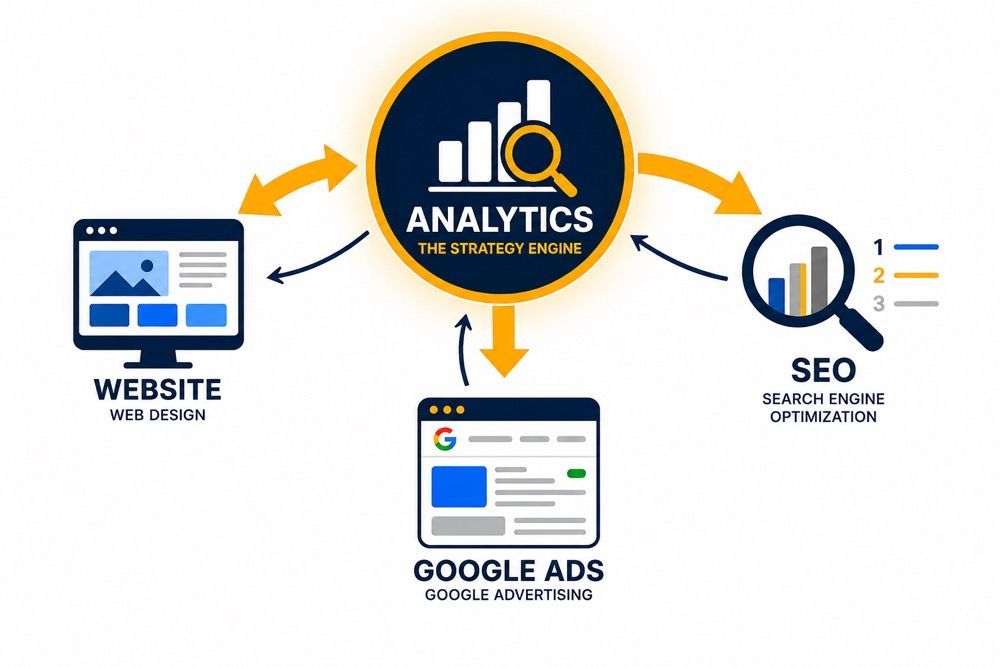
Analytics — The Strategic Engine
Your strategic engine. Competitor research, keyword intelligence, and conversion attribution that drives every decision the other three services execute.


Web Design
Your strategic foundation. A website built for search, conversion, and growth.

SEO Services
Your long-term growth engine. Organic rankings that drive free, compounding traffic.

Google Advertising
Your fast-start channel. Immediate visibility with leads from day one.
We also offer social media marketing, reputation management, and branding services as complementary components of a complete strategy. Ask us what makes sense for your business.
See the Approach in Action — For Free
The best way to understand how PMI's integrated approach would work for your business is to sit down with us and talk through your specific situation. We'll do a live competitive analysis during our first conversation — so you walk away with real intelligence about your market, regardless of whether you become a client.