

ANALYTICS — THE STRATEGIC ENGINE
Marketing Analytics That Drive Strategy
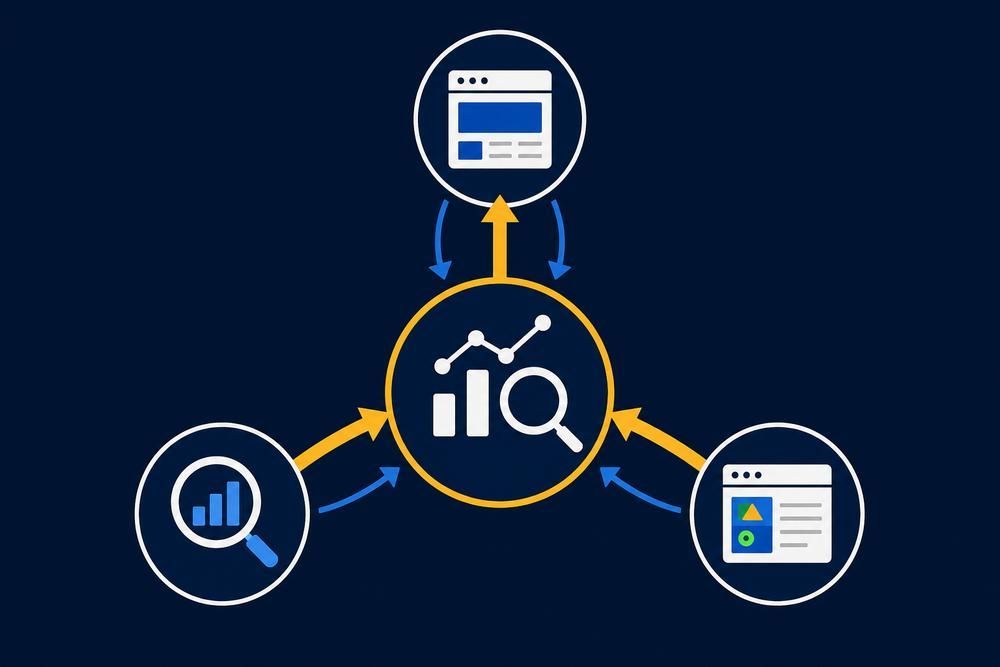
Analytics is the engine that drives every other digital marketing service we deliver — and that order matters. Web design, SEO, and Google Ads at PMI are not three independent services that happen to share a client. They are three downstream applications of the same analytical work: competitor research that exposes the gaps your competitors haven't closed, market intelligence that identifies the opportunities they haven't named, conversion analysis that tells you which traffic to invest in and which to abandon, and attribution that connects every marketing dollar to the revenue it actually produced.
Most analytics tells you what happened last month. PMI's analytics tells you what to do next.
PMI's analytical practice has been the engine underneath every client engagement since 2011 — built on a 30-year systems-integration discipline our founder developed long before "data-driven marketing" became a slogan. The analytical work has always been there. This page makes it nameable, makes it standalone, and makes it the single most strategic service available to a small or mid-sized business in Berks County or the Lehigh Valley that wants to compete with larger, better-funded rivals.

PROBLEM / AGITATION
What "Analytics" Means Almost Everywhere — And Why That Falls Short
Walk into any digital marketing agency in Pennsylvania and ask about their analytics service. You will hear some combination of the following: GA4 implementation, Looker Studio dashboards, monthly performance reports, custom event tracking, conversion goals. All of it useful. None of it strategic.
The reason is mechanical. Most agencies treat analytics as a deliverable rather than as a decision-making engine. They configure the tracking, they build the dashboard, they email it on the first of the month, and the client opens it, looks at the numbers, and asks the same question the agency hoped the dashboard would answer: now what?
That gap — between data presentation and strategic recommendation — is where almost every analytics engagement breaks down. The standalone GA4 consultancies handle implementation beautifully but stop at the dashboard. The full-service national agencies bolt analytics onto their existing services but rarely use the data to redirect strategy in real time. The SaaS competitor-analysis tools (SpyFu, Semrush, Ahrefs) produce mountains of data that few clients have the analytical training to interpret. And the result, across the industry, is the same: a small business owner who is paying for analytics but cannot use it to make a confident strategic decision.
PMI was built to close that gap. The analytical work we do is not a deliverable — it is the conversation we have with the client every month about where to push, where to pull back, where the competition is opening up gaps, and where the next 90 days of investment should go. The dashboards exist. The reports exist. But they exist to support the strategy conversation, not to replace it.
WHERE PMI SITS IN THE ANALYTICS LANDSCAPE
Four Kinds of Analytics Provider — and the Empty Quadrant Where PMI Lives
It is worth being specific about what the alternatives look like, because the structural advantage PMI offers is hard to see without the comparison. Four kinds of providers dominate the analytics market today:

The Tool Vendors
SpyFu, Semrush, Ahrefs, Similarweb. Software platforms that sell self-service access to data. Excellent at what they do. They produce no strategy — the interpretive layer is your problem. PMI subscribes to and operates the same toolset. The output of these tools is the input to PMI's analytical practice.

The National Full-Service Agencies
WebFX, EWR Digital, ALM Corp, and similar 100-plus-employee firms. Genuine full-service capability, including in-house analytics. The structural problem is the structure: at scale, the analyst who runs your competitor research, the strategist who shapes your content calendar, and the media buyer who runs your Google Ads are three different people on three different teams. Translation loss across handoffs is the price of scale. Fees are calibrated to the multi-layer overhead — a structural floor most small businesses cannot reach.

The Standalone Analytics Consultancies
GA4 specialists, Looker Studio shops. Technically excellent at implementation and dashboarding. They configure the measurement layer and the engagement ends. The strategic work that turns the dashboard into next month's plan is your problem.

The Local Generalist Agencies
Most regional agencies in markets like Berks County and the Lehigh Valley. Their service pages emphasize web design, SEO, and Google Ads. Analytics, when mentioned, appears as a bullet under SEO. There is generally no documented methodology, no strategic deliverable that survives the relationship, and no operator-CEO depth running the work directly.

The Empty Quadrant
Across these four segments, the intersection of genuine deep analytical work, integrated four-service execution, founder-led delivery, and an SMB price point is essentially empty. That empty quadrant is where PMI lives. The MABAS competitive landscape analysis, the anonymized Margaret S. case study, and the decade-long compounding results at American Insuring Group are evidence that this is not a positioning claim — it is a description of the work that gets done.
WHAT PMI ANALYTICS INCLUDES
The Analytical Work That Drives Every PMI Engagement
PMI's analytical service is organized around four practices that together form the foundation of every digital marketing strategy we recommend. Each one produces a tangible deliverable that a client owns regardless of whether they engage PMI for execution.
Competitive Landscape Analysis
The work that defines who you are actually competing with — by city, by service line, by deal range — and where each competitor is strong, where they are weak, and where they have left ground uncontested. The deliverable is a competitor scorecard with color-coded threat levels, a strategic position quadrant showing where you sit relative to the competitive set today and where you can move over 6 and 24 months, and an opportunity map that scores every candidate market on both short-term ad ROI potential and long-term SEO authority potential. This is the same methodology PMI applied for Mid-Atlantic Business Advisory Services — a 16-page competitive landscape analysis that mapped five direct competitors across the Pennsylvania M&A advisory market and surfaced the Lehigh Valley as the single highest-leverage zone in the entire footprint.

Keyword & Market Intelligence
The research that identifies which search phrases your customers are actually using — separated cleanly from the high-volume vanity terms that drain budget without converting. Every keyword in PMI's strategic deliverables is scored on three dimensions: monthly search volume, ranking difficulty, and buyer intent. The output is a keyword strategy document that becomes the spine of your website architecture, your SEO content calendar, and your Google Ads keyword targeting. It is the single document that ensures every dollar of marketing investment is pointed at the same set of search behaviors.
Conversion & ROI Analytics
Beyond GA4 implementation: the disciplined analytical practice of tracing every conversion back to the specific keyword, ad variant, landing page, or content piece that produced it. This is where most analytics engagements stop and PMI's starts. We configure full conversion tracking — call attribution, form submissions, e-commerce events — and we report on what is actually working at the level of business outcomes. Cost per lead by source. Conversion rate by landing page. Revenue attribution by channel. Compounding return on each marketing channel over a 12-month and 24-month horizon. The reports answer the questions a small business owner actually asks: which dollars produced revenue, and where should the next dollar go?
Strategic Synthesis & Roadmap
Where the discipline becomes a plan. Every PMI analytical engagement culminates in a written strategic roadmap with phased recommendations across three time horizons — 0–30 days, 30–90 days, and 90–180 days — tagged by funnel discipline (paid, organic, both) and by integration with the four PMI service lines. The roadmap is the document the client and PMI work from in monthly strategy reviews. It is also the document that has produced PMI's consistent multi-year client retention pattern: when the strategy is documented, measurable, and reviewed against actual outcomes, trust accumulates and the engagement compounds.
WHY INTEGRATION CHANGES EVERYTHING
The Integration Advantage — Why Standalone Analytics Falls Short
There is a substantial industry of standalone marketing analytics consultancies. They are technically excellent. They implement GA4 cleanly. They build Looker Studio dashboards that visualize the data faithfully. And then they hand the dashboard to the client and the engagement ends — leaving the client with beautiful data and no operational pathway to act on it.
PMI's analytics is structurally different because it lives inside an integrated marketing practice. The analyst who runs your competitor analysis is the same person who writes the website architecture that exploits the gaps that analysis surfaces. The analyst who scores your keywords by buyer intent is the same person who builds the Google Ads campaigns that bid on those keywords. The analyst who attributes revenue back to channel is the same person who shifts your budget allocation in next month's campaign. There is no handoff. There is no translation loss. The intelligence the analytics produces is acted on the same week it surfaces.
That structural integration is what makes PMI analytics different from a standalone analytics shop AND from a full-service agency that bolts a reporting layer onto existing services. We are an analytical practice that happens to execute marketing — not a marketing agency that happens to report on analytics. That order matters.
The Compounding Advantage
When the same team analyzes, strategizes, and executes, every monthly cycle produces intelligence that immediately reshapes the strategy. Search rankings improve because the SEO content was redirected toward what the ad data proved was actually converting. Cost per lead drops because the website was redesigned around the conversion patterns the analytics surfaced. Customer lifetime value rises because the email program was retargeted toward the segment the attribution analysis identified as highest-value. Over 12 to 24 months, this compounds into a marketing system that produces materially more output per dollar than any siloed approach ever could.
TYING IT TO GET FOUND. IMPRESS. CONVERT!
How Analytics Powers Every Stage of the PMI Tagline
PMI's tagline is GET FOUND. IMPRESS. CONVERT! Three commitments to a client. Analytics is the engine that makes each one operational.
GET FOUND
Analytics Identifies Where to Compete
Without analytics, "getting found" is an article of faith — you publish content, you bid on keywords, you cross your fingers. With analytics, getting found becomes a precise targeting problem: which search phrases convert, which geographies have the highest demand-to-competition ratio, which competitors have the weakest content moats in your specific market. PMI's competitive landscape analysis and keyword research turn the question of where to compete from a guess into a quantified opportunity map.
IMPRESS
Analytics Reveals What Actually Resonates
Impressing prospects is not a design exercise — it is a positioning exercise. Analytics tells you which messaging your prospects actually respond to (which landing page headlines convert at twice the rate of the alternatives), which proof points actually move them (testimonials from a specific industry segment that outperform broad social proof), and which visual hierarchy actually keeps them on the page. The website that impresses is built on data about your specific audience, not on aesthetic conventions.
CONVERT
Analytics Closes the Loop
Conversion is where analytics becomes operationally indispensable. Every stage of the conversion path — search query, ad click, landing page, form fill, sales conversation, closed deal — leaves a data trail. PMI's analytical practice traces that trail end to end and identifies the specific friction points where prospects drop off. We then redesign the friction-causing element, measure the lift, and lock in the improvement. The compounding effect of this discipline over 12 to 24 months is the difference between a website that converts at 2 percent and one that converts at 6 percent — for the same traffic.
PROOF — WHAT ANALYTICS HAS ACTUALLY PRODUCED
Real Outcomes from PMI's Analytical Practice
The analytical work documented above is not theoretical. It has produced measurable outcomes for PMI clients across industries, geographies, and engagement durations. A representative sample:
The M&A Competitive Landscape Analysis
PMI delivered a 16-page competitive landscape analysis for a Pennsylvania M&A advisory firm targeting the $5–15 million deal range. The analysis mapped five direct competitors — including a national firm claiming 17 Pennsylvania counties of coverage and a content-led national M&A authority with offices in two of the same cities — across geographic match, deal range overlap, short-term ad threat, and long-term SEO threat. The output included a competitor scorecard, a strategic position quadrant with 6-month and 24-month trajectory targets, an opportunity map dual-scored across short-term ad ROI and long-term SEO opportunity, and a phased recommendations matrix tagged by funnel discipline. The analysis identified the Lehigh Valley specifically as the single highest-leverage zone in the entire footprint and produced a compounding 24-month roadmap. That is what PMI's analytical practice produces when applied to a real strategic problem.
American Insuring Group — A Decade of Analytics-Driven Compounding
A 20-year-established Pennsylvania insurance agency engaged PMI for an SEO-first website architecture combined with a metronome-cadence content marketing program. PMI's analytical practice — keyword research, content gap analysis, monthly attribution reporting — has driven that program for over a decade. The agency now generates almost all of its new business from the website, including some of the largest trucking-insurance leads in their market, with no cold-calling effort and no recurring ad spend. President David Ross summarizes: "Your content marketing strategy keeps proving itself year after year. Instead of cold calling, our efforts are now focused on following up on the multiple high-quality website leads we receive weekly. The return on investment has been outstanding." That is what analytics-driven content discipline produces over a 10-year horizon.
The Margaret S. Case Study — Analytical Discipline Crossing Domains
When a former apparel-industry executive approached PMI informally about a non-marketing problem — a family member's situation requiring structured analytical work outside PMI's usual scope — the same five-stage framework PMI applies to every client engagement (Discover, Clarify, Investigate, Synthesize, Deliver) produced a 17-page strategic briefing and a 9-page time-phased action checklist in three hours. Zero revisions requested. The case study has been documented as a client-facing artifact precisely because it demonstrates what most agencies cannot demonstrate: that the discipline is real, it is portable, and it produces structurally sound output regardless of the domain.
WHAT MAKES PMI ANALYTICS DIFFERENT
The Structural Reasons PMI's Analytics Outperforms
Founder-Led Analytical Work
Every PMI client's competitor analysis, keyword research, and strategic synthesis is executed personally by Alan Robezzoli — the agency's founder and the holder of a 30-year integrated systems-and-marketing discipline that runs from custom ERP architecture for Pennsylvania manufacturers to Executive Vice President of Marketing & International Sales at Elite Sportswear, where the analytical practice produced a top 2 percent national ranking in website marketing effectiveness and international expansion that grew the distributor network from one to thirty distributors in three years — culminating in an exclusive worldwide Adidas licensing agreement. There is no junior analyst running your data. There is no offshore team filling out a templated report. The strategist who has done the work for three decades is the strategist running your account.
Big-Agency Results at a Fraction of the Cost
PMI's lean operational structure — senior strategist directly on every account, hand-picked specialist network handling production, no account managers and no project managers and no junior staff billing through a multi-level pyramid — produces analytical work at a price point that larger agencies structurally cannot match. A comparable competitive landscape analysis from a regional or national agency typically costs two to three times what PMI quotes for the same scope. Same depth of work. Same quality of output. Different overhead structure underneath. That is the math that has produced PMI's consistent multi-year client retention pattern.
Built for Sophisticated Clients
PMI's analytical work is calibrated for clients with substantive growth ambition and the willingness to act on what the analysis surfaces. The MABAS engagement is representative — a firm targeting a $5–15M deal range, competing against national platforms, that needed the kind of quantified competitive intelligence and phased-recommendations roadmap that most small businesses do not require. PMI is structured to deliver that level of work directly, without the friction or pricing of a national consulting firm.
Integration That Compounds
The analytics service can be engaged standalone for clients who want the intelligence and intend to execute internally or through other vendors. But the highest-leverage configuration is integration: PMI runs the analytics, drives the strategy, and executes the web design, SEO, and Google Ads work that the analytics points toward. Every monthly cycle reinforces every other component. Over 12 to 24 months, the integrated configuration produces materially more growth than any standalone or siloed alternative.
PRODUCTIZED SERVICES POWERED BY ANALYTICS
Specific Services Driven by PMI's Analytical Practice
Some of PMI's analytical output is delivered as ongoing strategic guidance inside an integrated engagement. Other deliverables are productized — defined in scope, priced predictably, and engaged as standalone work for clients who want a specific output without committing to an ongoing program. The following productized services are anchored to and driven by PMI's analytical practice.
Strategic Press Release Distribution
Press release distribution as an off-page SEO investment, not as publicity. PMI writes the release, distributes it across regional and industry-relevant news syndication networks, and tracks backlink and citation pickup. Useful for service launches, community involvement, notable client wins, and milestone announcements. The strategic angle: which release timing, framing, and target outlets actually produce backlink lift — informed by the same competitor analysis that drives the broader SEO strategy.
Local Citation Building
Comprehensive local citation construction across the dozens of directories, maps, and industry-specific platforms that drive local search visibility and Google Business Profile authority. PMI handles the build, the consistency audit, and the ongoing maintenance that keeps your NAP data clean across the citation graph. The analytical layer: which citations actually move the needle in your specific market — informed by competitor citation profiles and local pack analysis.
Keyword Strategy Briefings
A standalone keyword strategy document, scoped and priced as a one-time deliverable. The output: a keyword universe scored on volume, difficulty, and buyer intent; a recommended targeting hierarchy across pillar terms, supporting terms, and long-tail; and a content calendar mapped to the keyword set. This is the same deliverable that anchors PMI's integrated SEO programs — available as a discrete project for clients who want to execute internally or through another vendor.
Content Strategy & Production
PMI's metronome-cadence content programs — visible in the decade of compounding results at American Insuring Group — are available as a scoped service. Includes editorial calendar development, primary keyword targeting per piece, full draft production through PMI's specialist network, and monthly performance reporting tied to organic traffic and lead attribution. The analytical layer: which content topics, formats, and publication cadences actually drive measurable lead volume — informed by the keyword research and competitor content analysis that anchors every program.
Each of these services is engaged independently or stacked into a broader PMI engagement. Pricing is project-based for one-time scope, monthly retainer for ongoing programs.
ENGAGEMENT MODELS
How to Engage PMI's Analytical Practice
PMI offers analytics in three configurations, each calibrated to a different client situation.
Standalone Strategic Intelligence Briefing
A one-time competitive landscape analysis, keyword & market intelligence study, or strategic synthesis engagement. The deliverable is a written strategic document — typically 12 to 20 pages, in PMI house style, with all supporting visualizations — and a 90-minute strategy review session. The client owns the document outright and can engage any vendor (PMI or otherwise) to execute against it. This configuration is appropriate for clients who want the intelligence and have execution capacity in place.
Ongoing Analytics Program
Monthly analytical work integrated into a multi-service PMI engagement. Includes ongoing competitor monitoring, keyword strategy updates, conversion attribution analysis, monthly strategic reviews, and quarterly roadmap updates. Configured at the analytical depth and frequency the client's engagement requires.
Integrated Strategic Engagement
PMI runs the analytics, drives the strategy, and executes the marketing work — web design, SEO, Google Ads, content — that the strategy points toward. This is the configuration where the integration advantage compounds most aggressively over time. Most PMI clients who engage at this level remain engaged for multiple years because the integration itself produces measurable improvement quarter over quarter.
LOCATIONS & INDUSTRIES
PMI Analytics Across Berks County and the Lehigh Valley
PMI's analytical work is calibrated to specific markets. The competitive landscape in Berks County is structurally different from the landscape in the Lehigh Valley. The keyword behaviors that produce conversions in Wyomissing are different from those that produce conversions in Bethlehem. PMI's analytical practice is built around that geographic specificity from offices in Reading and Allentown.
Analytics Services in Berks County
Reading, Wyomissing, Boyertown, Kutztown, Hamburg, Fleetwood, Birdsboro, West Reading, and all of Berks County.
Analytics Services in the Lehigh Valley
Allentown, Bethlehem, Easton, Whitehall, Emmaus, Nazareth, Center Valley, Macungie, and all of the Lehigh Valley.
Industries Served by PMI's Analytical Practice
Web design strategy varies significantly by industry — the conversion behavior, search terms, and trust signals that work for a trades contractor are completely different from those that work for a healthcare practice or a professional services firm. PMI has built websites across a wide range of industries over the past 15 years, and that experience shapes the strategy behind every new project.
INDUSTRY LIST






Frequently Asked Questions About PMI's Analytics Practice
Is PMI's analytics service different from Google Analytics?
Yes — fundamentally. Google Analytics 4 is a measurement platform that records user behavior on your website. PMI's analytical practice uses GA4 (and other data sources) as raw inputs to produce strategic intelligence: competitor positioning, market opportunity mapping, ROI attribution, and phased recommendations. GA4 tells you what happened on your website. PMI's analytics tells you what to do about it.
How is this different from a standalone GA4 consultancy?
Standalone GA4 consultancies typically focus on implementation, configuration, and dashboard production. They are technically excellent at those tasks. PMI's practice extends well beyond GA4 — into competitor analysis, keyword and market research, conversion attribution, and strategic synthesis — and it is structured to drive marketing strategy and execution rather than to hand off a dashboard. Many PMI clients have a GA4 consultancy for implementation and PMI for strategy. Some choose PMI to handle both.
Does PMI cover AI search visibility — "AI SEO" or Generative Engine Optimization?
AI-search visibility (sometimes called Generative Engine Optimization, GEO, or LLM Optimization) is a real and growing dimension of search behavior — and it is part of PMI's ongoing analytical mandate. We monitor AI overview citations, brand mention patterns across LLM-driven search, and the structural site signals that influence whether a business appears in AI-generated answers. PMI does not currently sell a discrete "AI SEO" productized service line; we treat AI visibility as a component of the broader analytical and SEO work, and we expect to formalize a productized offering in a future phase as the methodology stabilizes industry-wide.
What does an analytics engagement actually cost?
Pricing depends on scope. A standalone strategic intelligence briefing is typically a fixed-fee project quoted after a free consultation that defines the scope. An ongoing analytics program is a monthly retainer scaled to the analytical depth the engagement requires. An integrated strategic engagement combines analytics with the marketing services that act on the strategy. PMI's pricing structurally undercuts comparable agencies by avoiding the multi-layer overhead model — which is why the math works for small and mid-sized businesses that could not afford the equivalent engagement at a national firm.
How quickly can PMI produce a competitor analysis?
A focused competitor analysis on a defined service area and competitive set typically completes within two to three weeks of engagement. Larger landscape analyses with multiple service lines, broader geographies, and deeper competitor coverage typically run four to six weeks. The analysis is not rushed — the value is in the depth of the work — but PMI's analytical engagements complete substantially faster than what national consulting firms quote for comparable scope.
Can I engage PMI for analytics without buying execution services?
Yes. PMI's analytical practice is available as a standalone engagement. The deliverable is yours to act on however you choose — including engaging vendors other than PMI to execute. That said, the highest-leverage configuration is integration, because the integration eliminates the translation loss that occurs when analysis is handed off to a separate execution team.
What kind of growth-stage clients does PMI work with?
PMI is structured for sophisticated clients with substantive growth ambition — firms targeting meaningful revenue growth, entering new geographic markets, repositioning against larger competitors, or building toward an exit. PMI also accommodates high-potential, low-cash growth clients through alternative engagement structures (revenue-share configurations with cap step-down protection on both sides). The common thread across PMI's client base is the willingness to commit to a real strategy and stay with it long enough for the integration to compound.
How does PMI handle confidentiality on competitive analysis work?
Every PMI analytical engagement is governed by a written confidentiality agreement that covers both the input data the client provides and the output document PMI produces. Strategic landscape analyses are structured to be safely sharable internally without disclosing client identity to the competitors being analyzed.
Start with a Free Strategic Intelligence Briefing
A free PMI consultation includes a 60-minute strategy session with Alan Robezzoli, a live competitive analysis of your specific market, and concrete intelligence about where your business currently sits competitively — regardless of whether you become a client. You walk away with usable strategic information about your market position. PMI walks away with a clearer sense of whether the integrated discipline is the right fit for your situation.
No commitment. No high-pressure pitch. Just structured analytical work applied to your specific business, at no cost, in 60 minutes.