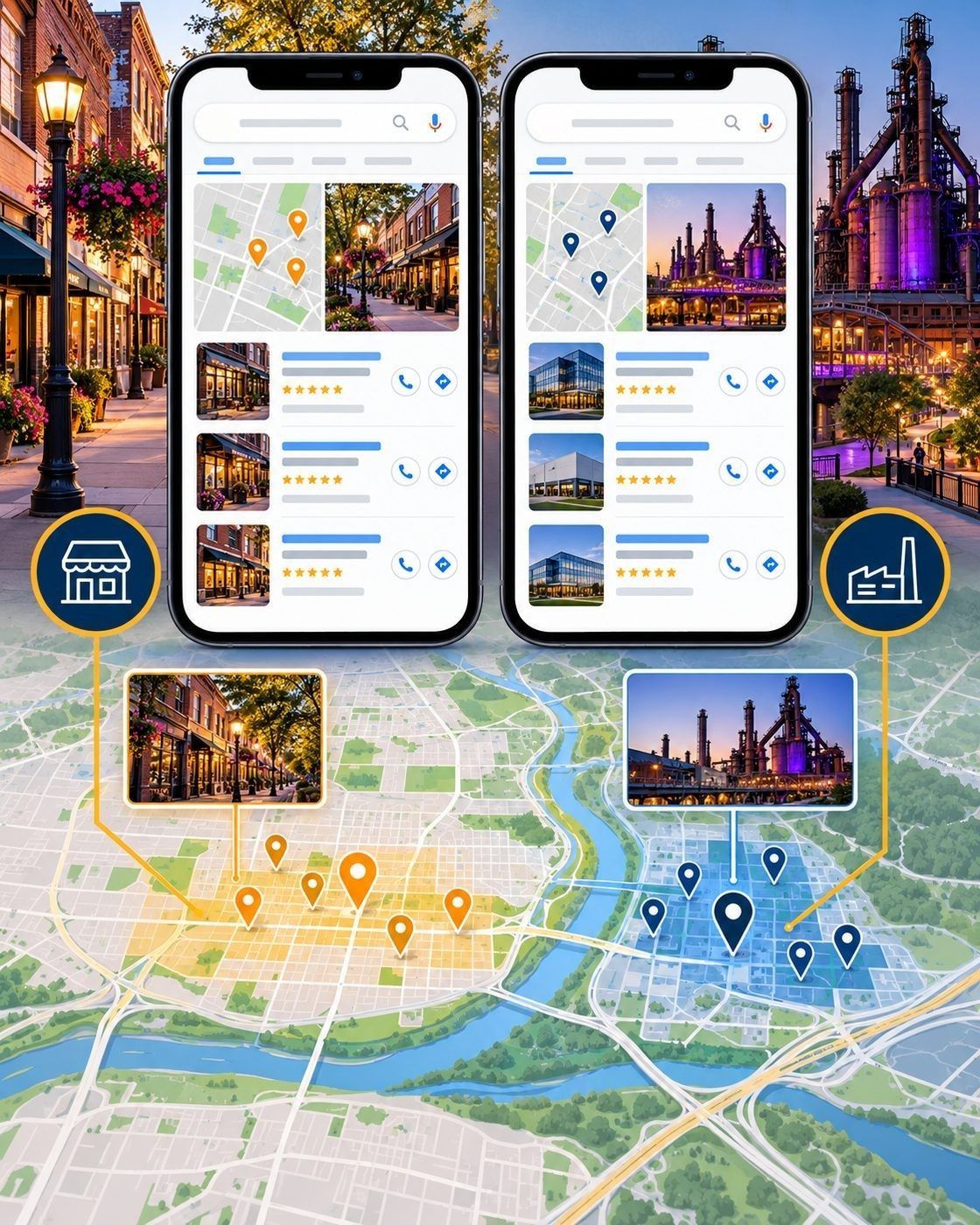
Most regional SEO programs treat Bethlehem as a single Lehigh Valley sub-market. Google's local algorithm reads it differently. Geographic relevance signals, content topical authority, and search intent classification all behave as if Bethlehem is two related but distinct ecosystems.
Main Street Bethlehem is a consumer-intent retail and dining environment with a customer base trained by years of curated downtown experience to evaluate businesses against intentional standards. Search behavior is heavily mobile, dominated by Map Pack and reviews-driven discovery, with strong long-tail intent around specific dining categories, retail specialties, and heritage tourism. The competitive set is mostly other Main Street businesses — and visibility wins go to businesses with strong GBP optimization, consistent local citations, and active review management.
The SteelStacks corridor and Lehigh University research economy operate on B2B and professional-services dynamics. Search intent is researcher-mode, often involving multi-stakeholder evaluation processes.
Cost per click on competitive verticals can be high. The competitive set frequently includes regional and out-of-area firms competing for Bethlehem-positioned B2B opportunities. Winning here requires content depth, topical authority, and the kind of sustained content cadence that builds genuine expertise signals.
PMI's Bethlehem SEO programs segment the strategy explicitly. A Main Street retailer or restaurant gets a Main Street program — local-pack-focused, mobile-first, citation and review heavy.
A SteelStacks-corridor B2B firm gets a SteelStacks program — content-cadence-heavy, expertise-content focused, longer-cycle authority building. Hybrid businesses get both, structured cleanly enough that neither mode bleeds into the other.